
Laptop twee, Lena “voice of a generation” Dunham’s Girls 2.0, and the return of horizontal Flickr photos?! Why 👏 is 👏 twee 👏 fucking 👏 everywhere?!
by Aurora Rossa Manni
Some months ago I woke up to find Alexa Chung all over my feed again. Still half-asleep, it felt like an eerie fever dream, with a strange sense of déjà vu, as if I’d been transported back to 2012. I couldn’t help but wonder… Had the trend cycle shortened so much I was already reliving my teenage affectations barely a decade later? Had I just survived the coquette epidemic only to witness the return of its grandparent, twee?
Twee: excessively dainty, delicate, quaint or cute. Originally English baby talk (a child’s pronunciation of “sweet”). Started as a sub-genre of the British indie scenes of the late 1980s and 1990s, entering the cultural mainstream around 2010, evolving from a niche musical aesthetic into a broader ethos that has shaped fashion, cinema and internet culture. Peter Pan collars, flats over heels, polka dots, hand-drawn illustrations, playful tunes and irony. 1960s counterculture, slightly annoying quotations of French New Wave, 1950s good-clean-fun rhetoric and 1990s indie inwardness. A retromaniac pastiche assembled from whatever might have passed as good-hearted in the previous century. Cultivated loser aesthetics, DIY, non-performative and only incidental sexiness (think American Apparel, whose appeal lay in being playful, awkward and tongue-in-cheek). Soundtrack: Belle and Sebastian, Camera Obscura, She & Him, Neutral Milk Hotel, Peter Bjorn and John, The Moldy Peaches, Regina Spektor, and Coconut Records.

I remember an article in the Italian press proudly proclaiming: “We’re not hipsters, we’re TWEE!”, accompanied by a giant portrait of a grinning Wes Anderson. My mum meticulously cut it out and gave it to me. Back then, I was permanently online pinning photos, as if “coolhunting” was my job, or could somehow become one.
I was a shy kid, so the twee aesthetic moved me more than anything else in the scene. I wasn’t a hipster – I was delicate, as the newspaper cut-out my mum had handed me proclaimed. I was drawn to twee’s vision of the 1950s and 1960s; to the idea that one could move through the world with grace, gentleness and brilliant ideas. No need to be loud or aggressive. Twee wasn’t optimistic per se, but it wasn’t pessimistic either – with films like Beginners, Juno, (500) Days of Summer, Garden State, Submarine, Tiny Furniture, Napoleon Dynamite, Me and You and Everyone We Know and all things Wes Anderson being great examples of its soft yet melancholic sentiment: bittersweet, like Billy Wilder on Xanax.

Looking back, the 2010s feel like the instant before a collapse, a time when uncertainty was a gift of freedom, kind of like reading Nietzsche for the first time in high school. The “Old Gods” (the reassuring script of the nuclear family and the disciplinary institutions of Fordist capitalism) had long been dead, killed in part by our parents on cocaine and bad investments. In their place stood the new millennial myth: we’d be broke, but happy and original. No house and no savings, but the world as our stage.
The 2008 financial crisis had exposed the cracks in the neoliberal promises of social mobility and meritocracy, but the idea that the internet and social media could democratise talent and open up new paths into creative work was everywhere. After all, as Adam Curtis might argue, one of late capitalism’s greatest tricks was convincing us that self-expression itself could become a viable economic model.
There was some kind of acceptance of collective chaos and instability in the spirit of twee and the taste surrounding it. Faith in this new-age medicine had us believing that although we might never get a retirement plan, perhaps we could make a living by writing witty takes for Vice and spend our best years doing what felt true to us. Even if the whole thing was mediated by a complicated economy of taste and cultural distinction, there was a certain pleasure in believing that our eccentricities could amount to something – that self-expression might one day lead us to, if not owning a house, then at least living an interesting, authentic life.


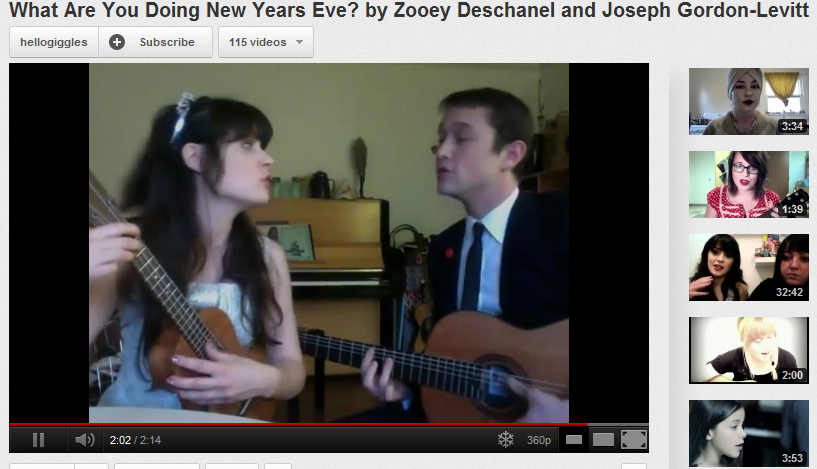
So, in the current virtual world of infinite possibilities, why this sudden return to twee? Why is Alexa Chung all over my feed? The once-cancelled Lena Dunham is so back, with five new episodes of HBO’s Girls just announced; every other well-read it-girl spent the summer sunbathing with Famesick in hand. Zooey Deschanel is enjoying a moment, while the bands that defined the twee era go on tour again. Flickr-style horizontal formats and single-image posting (being aggressively anti-9:16) have made a comeback. Delicate, naïve fashion labels like Lucila Safdie are already spawning countless fast-fashion imitations, with their shoegazing models, polka dots, headbands and star motifs. Girls in music look bon ton, albeit with a sharper, sassier wit – think Clairo, Smerz, or Nina Cristante of Bar Italia. There is also a whole discourse going about Laptop Twee, a term coined to describe the new wave of bands like ear, Bassvictim, and so on. Also I just forced my boyfriend into a Los Angeles Apparel store, just like in the good old days. Why twee, and why now?!
Sure, the younger version of me that existed in 2012 was way more confident in her own narrative than the one sitting here now, hunched over an iPhone 16 brain extension, saturated in slop and fake news, watching the institutions that once exercised some kind of cultural authority lose their grip on it. I used to have so much faith in the now-outdated neoliberal promise: that self-expression and communication, especially via the digital world, could offer both a way of making sense and a way of making a living. Today, it feels uninspiring, if not unsafe, to present myself online. Is that why we keep exhuming this 2010s corpse of the past, hoping to recover a version of reality that once felt comprehensible and habitable? Are we collectively performing innocence and spontaneity in order to feel real again?


My first thought upon seeing all the things that made me quirky in high school return as mainstream trends was simply: wait, already? There is, of course, nothing new about cultural revival: by the end of the twentieth century, the recycling of the past had become an increasingly dominant cultural logic. Fredric Jameson argued that late capitalism had lost the ability to imagine convincing futures, turning instead towards the recycling of the past through pastiche. Simon Reynolds later named this tendency retromania: the internet-age obsession with reviving and recombining previous cultural forms. Mark Fisher developed this through Derrida’s hauntology, suggesting that what keeps returning are ghosts of futures that late capitalism gradually foreclosed.
For Fisher, ghosts were traces of futures that never arrived, lingering in the cultural present primarily through recordings, broadcasts and media archives. Twee is already a haunted aesthetic, assembling idealised fragments of twentieth-century material culture – Polaroids, vinyl records, cassette tapes, second-hand books, handmade objects – and translating them into the digital realm. The ghosts reached the present as scattered fragments and lost ephemera, requiring acts of recovery or invocation. Their power came from their absence as much as from their persistence.


The internet we inhabit today seems to force us to extend that diagnosis one step further. Rather than functioning merely as an archive, preserving traces to be recovered, it actively prevents the past from fully receding. Tumblr blogs, Instagram accounts, playlists, photographs and online identities survive as though they had never left: searchable, accessible and endlessly reproducible. They possess an eerie kind of immanence. The generations now rediscovering twee may be the first to inherit a past that was fully born online and never had the chance to decay. It floats, physically intact, inside a permanent virtual aquarium.
Instead of a spectre reconstructed from memories in the form of fragments, we stand before a digital body that never left. The figure that comes to mind as an extension of the ghost is the zombie: a dead thing whose body never fully disappeared, suspended in a strange state of animation, neither alive nor gone. The first generations to grow up permanently online have left behind an unprecedented amount of cultural residue. Alexa Chung exists online as both her present self and her 2012 self. Ali Michael answers questions on her current Tumblr while her original one still sits online beside it.


This may affect identity itself. While becoming someone new – the very idea of a future – requires distance from who you were, a past that remains inhabitable and strangely alive becomes increasingly difficult to leave behind. Cultural forms circulate like undead bodies through the necromantic machinery of the platforms that increasingly structure our lives. What appears to be a shortening of the trend cycle may in fact be its disappearance: a complete flattening of time.
There is a shared and unspoken emotional atmosphere in every generation, operating before it solidifies into ideology or institutions, in which personal experience and historical conditions become indistinguishable. The defining structure of feeling of the early 2010s grew within the “slow cancellation of the future,” as collective horizons narrowed and capitalist realism haunted an increasingly uninhabitable social landscape. Against this backdrop, the idea that individuality could still lead somewhere became all the more emotionally persuasive, especially through the promises of early social media.


With the traditional promises of homeownership, job security, and family stability long dead, the fantasy of the “good life” was relocated to creativity, taste, and self-expression. The exposure of the self-in-progress seemed capable of turning personal expression into financial independence, beyond merely fostering connection. Emerging from within the crisis rather than in opposition to it, this fantasy turned the self into both the last available promise of emancipation, and a new site of capital accumulation. This palliative kept the system alive through a playground of creativity and self-expression that felt like freedom, generating an extraordinary period of cultural experimentation, until it started being commodified and saturated by the very platforms by which it had been enabled.
Twee’s experimental, nostalgic aesthetic borrowed the language of a “sweet” past to evoke a life-affirming sensibility against that growing sense of doom. It is this emotional structure, along with its aesthetic vocabulary, that has returned today: a revival of the revival, as though we were craving the craving for hope itself, still unable to move on from the last moments of creative labour seemingly being capable of offering a viable horizon of meaning, and an independent life. The traces of that period remain physically available online, while the aspirations at its core have never been fully metabolised. Questions of authenticity, creative work, online identity, and cultural participation remain open wounds and have become, if anything, even more heavily weaponised.


The appeal, then, of Lena “a voice of a generation” Dunham’s naïve narcissism, is that it recalls a time when people were willing to turn their own lives into material from which to fashion a public spectacle of becoming, before every act of self-expression became quite so entangled with calculations of social (or real) capital. Yet there is something inevitably awkward about the staged video-call announcement of the Girls return: the sense that we are all knowingly taking part in a performance bound to fall short, staging a period drama that can never quite live up to our longing for it because the present will not allow the past to play out in quite the same way. The return of twee thus embodies our will to be emotionally invested in fantasies that organise our desires even after they have ceased to sustain our flourishing, especially when we cannot find an alternative or a way to adapt. What emerges is a kind of intergenerational mourning for the millennial love affair with uncertainty, haunted by the hope, in Obama font, that through little polka-dotted cultural rituals, we might recover the lost art of generative imperfection and finally regain a sense of futurity.