

The micro-history of the front-facing camera
About twenty years ago, Paris Hilton and Britney Spears “invented the first selfie ever.” While this probably isn’t historically accurate, it is true in the sense that it reified the selfie as a mass-cultural phenomenon. The selfie, showing Paris and Britney smiling at the camera, their bleached-blonde hair forming the shape of a heart, was not shot with a front-facing camera that we all know and recognize today, but with the back camera of her custom Hello Kitty rhinestoned Blackberry Touch 9800.
Almost two decades later, the two reunited for another selfie. Since their last interaction, a lot had changed: Britney had survived a thirteen-year abusive conservatorship; Paris had been surpassed in cultural relevance by her former assistant, Kim Kardashian; and, more importantly for this text, the front-facing camera had been invented. Viewed side by side, these differently technologically mediated selfies appear similar, yet a trained eye will recognize a crucial difference. In the earlier image, they look directly at the camera; in the later one, their gaze seems to drift away. The former is constituted by a feeling of presence, the latter by a haunting detachment.
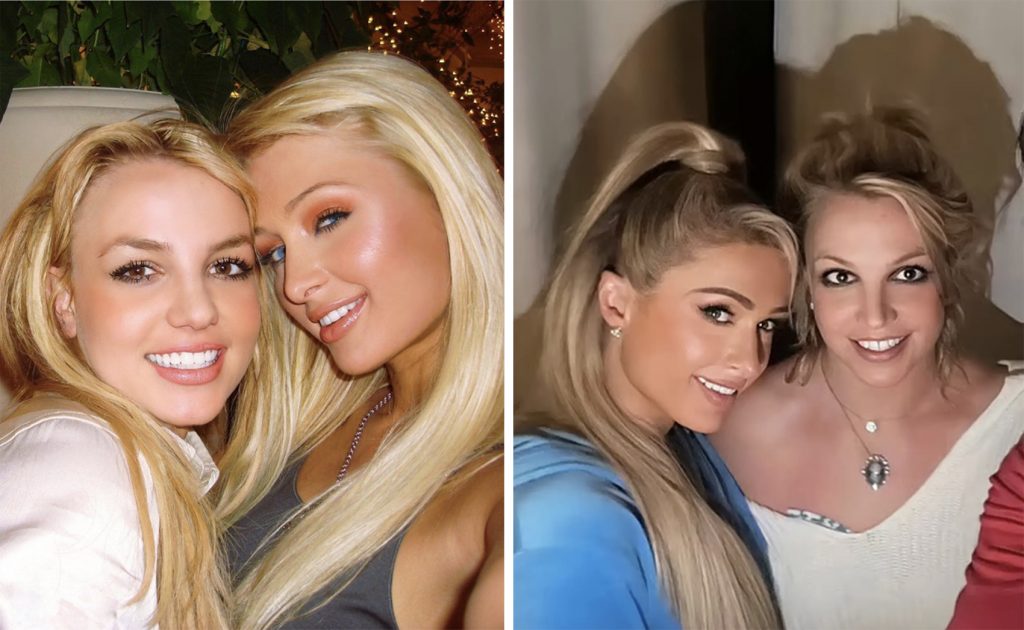
The difference does not seem to be a matter of chance or selection bias, but of design. While the back camera encourages the selfie-taker to look straight into the lens, and therefore directly into the viewer’s eyes, the front-facing camera, through its preview, encourages subjects to look at themselves. As a result, the viewer is no longer met with direct eye contact through the screen. Instead, there is a disconnect, a break in visual reciprocity.
Aside from carrying symbolic weight – a form of disembodiment and compulsive self-awareness characteristic of the post-social media landscape – this small perspectival shift also produces a difference in how the selfie operates. Before the front camera, you took a picture of yourself. After it, you took a picture while looking at yourself.
What interests me here is not simply how the front-facing camera popularized the selfie – something we are all already aware of – but how it fundamentally transformed its visual logic: reconfiguring relations of gaze, presence, and self-perception in ways that continue to shape how we see ourselves online.
Voyeurism by Design
An important consequence of this shift is how it relates to the viewer, a relationship that can be explored by taking a look at the trope of Susanna and the Elders in art history. This trope is based on a biblical narrative in which Susanna, a young married woman, goes out into a garden to bathe, believing herself to be alone. She is secretly observed by two older men who later threaten to accuse her of adultery if she does not submit to them.

As John Berger notes in Ways of Seeing (1972), Susanna is rarely depicted meeting the gaze of either the Elders or the viewer. Instead, she appears self-conscious, averting her eyes or covering her body, as if already aware of being watched. The viewer is implicitly aligned with the Elders, positioned as an unseen observer, while Susanna’s awareness of being seen becomes part of the image’s structure. In other words, because Susanna is looking away. This allows us, as viewers, to look at her naked body without being implicated in the act of looking.
If this logic is applied to the front-facing camera selfie, a similar configuration emerges. As the subject’s gaze is directed toward their own image on the screen rather than toward the lens, the viewer is no longer met with direct eye contact. Instead, the viewer occupies a position analogous to that of the Elders: watching someone who is already watching themselves. The selfie thus produces a situation in which the act of looking is asymmetrical and unreturned, allowing the viewer to consume the image without being acknowledged by it.
This voyeuristic relationship to the viewer, combined with the fact that front-facing camera selfies are taken while monitoring one’s own image in real time, produces a paradox. On one hand they encourage an intense fixation on appearance but they also produce strategies of concealment. Selfie culture and the aesthetics that arise from it can therefore be understood as a constant negotiation between these two opposing forces.
This dialectic becomes visible in the demand for Snapchat filters, as well as in the abundance of TikTok tutorials with titles such as “best selfie poses for shy guys,” “3 easy selfie ideas if you don’t like showing yourself,” and “shy girl selfie ideas.” What emerges from these videos is a shared repertoire of poses: the “low angle, look up,” the “head to shoulder,” “hold drink & hide,” or the peek-a-boo framing. Visibility here is not an endpoint but a process negotiated through its opposite: to appear, the face must also learn how to hide.
A personal favorite within this repertoire is the highly specific 2016 Snapchat selfie: shot over the shoulder, the phone slightly tilted, the face partially obscured by the subject’s hand. Another favorite is its more masculine counterpart, which I associate with Justin Bieber and the thirst-trapping MAGCON boys of the same era: hands covering the mouth, eyes lifted and smizing into the screen.

Smoothed by Design
Speaking of this very particular era of selfie culture, let’s turn to another aesthetic trend of the time – one that similarly has a strange connection to the technical constraints of the front-facing camera: the 2016 cakey makeup trend. This trend, prophesied by the likes of Kylie Jenner, James Charles and Kim Kardashian, was characterized by block eyebrows “on fleek,” hypervisible contouring and bold overlined lips. Because of its almost drag-queen–like exaggeration, once this era of makeup passed, it left many wondering what allowed this level of clownery to occur in the first place.
Though cultural factors of course played an undeniable part, podcaster Alexi Alario in the Nymphet Alumni episode “Snapocalypse” makes an interesting point about the relationship between resolution and makeup trends. In it, she argues that heavy contouring and thick foundation appeared acceptable partly because low-resolution Snapchat cameras (front cams) smoothed and blurred the image, allowing extreme makeup without visible texture. In this sense, the front cam functioned less as a neutral recording device and more like a beauty blender – or, more accurately, like theatrical makeup itself. As with stage makeup, where exaggerated techniques are designed to read at a distance and under low-detail conditions.

Conversely, the cakey makeup trend itself can be understood as a form of theatrical makeup. In theatre, makeup is deliberately exaggerated to compensate for distance and limited visual clarity, ensuring that facial features remain legible under constrained viewing conditions. Similarly, cakey makeup operated as a form of digital stage makeup, calibrated to the technical limitations of low-resolution front-facing cameras. Snapchat became the performance stage, and the front-facing camera its mediating surface.
The revisionist take, that people in 2016 were simply “crazy,” is therefore not true. In fact, the decline of this aesthetic and the rise of “clean girl” makeup can be interpreted as influenced by improved front-camera resolution, which suddenly made heavy contouring hypervisible. A similar logic can be seen in the proliferation of smoothing and beauty filters. As cameras became too sharp to function as implicit softening devices, digital filters stepped in to assume this role, artificially removing discoloration, pores, and other perceived imperfections. Despite these technological stand-ins for the original beautifying blur of the front cam, people appear to remain aesthetically anchored in 2016. Countless TikToks circulate demonstrating how to recreate the “low quality aesthetic” selfie and filters have been developed to artificially degrade image quality to 2016-era resolutions.

Ugly by Design
While it is true that the front-facing camera once functioned as a beautifying filter, it paradoxically also began to operate in the opposite direction. Plastic surgeons, for instance, increasingly identify the front camera as a factor in the rise of facial dysmorphia and the growing demand for cosmetic procedures. This is not only due to the self-scrutiny enabled by selfie-devices, but also to the camera’s concrete technical properties.
Front cameras are designed for selfies, which implies that they are used at arm’s length. To capture the entire face at this close distance, they rely on wide-angle lenses, which distort facial proportions by widening the face, enlarging the nose, and shrinking the eyes. This produces a technical contradiction: a camera designed to bring the face closer simultaneously produces an image that feels less like one’s own. And since all of these distortions run counter to Western beauty standards, they are internalized as personal defects – fueling desire to correct the face rather than the camera.
We therefore arrive at a strange societal condition in which people undergo plastic surgery to correct features they do not actually possess. Or perhaps this is not so strange after all. If digital representations of the self have come to outweigh any stable notion of a “real” appearance, then altering the body to match its mediated image may no longer seem misguided, but entirely logical.
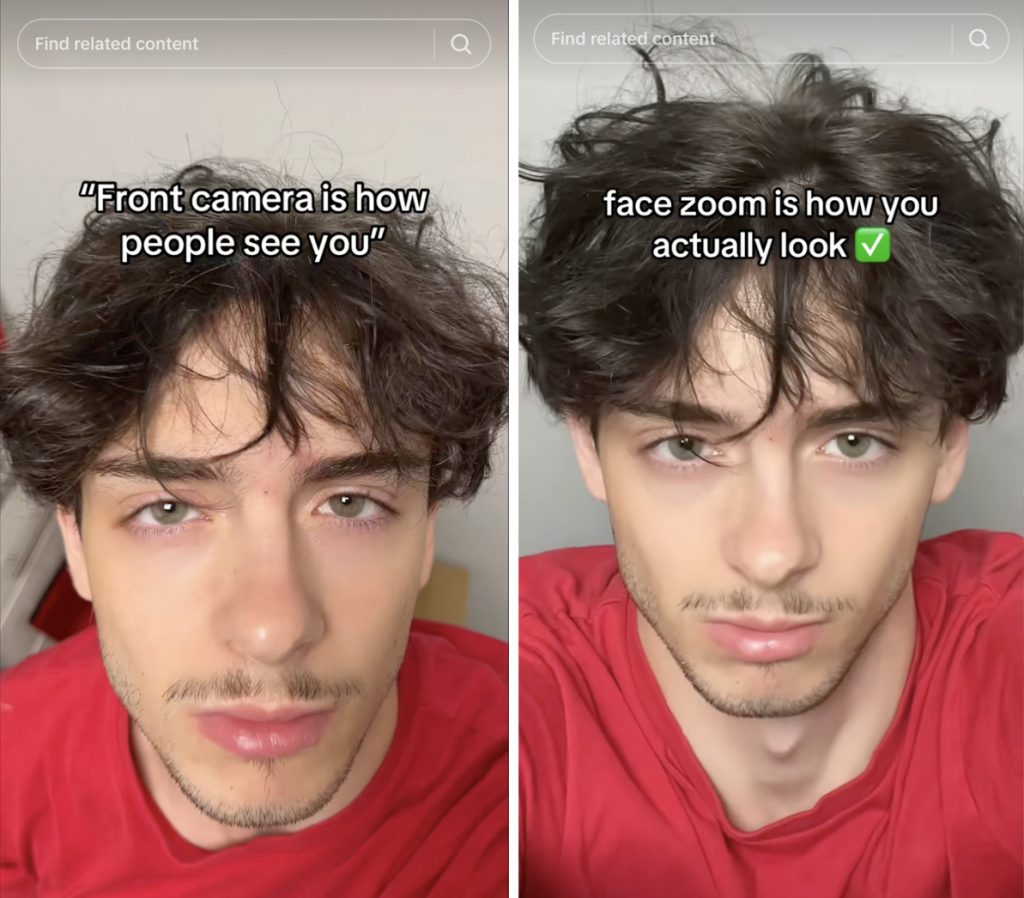
As users have become aware of the distortions of the front cam, they have created counter-strategies to “fix the face.” Advice circulates to use the back camera instead, to take selfies via mirrors, or to rely on corrective TikTok filters such as “face zoom.” Much like the low-resolution filters developed to compensate for ever-sharper front cameras, these practices deploy skeuomorphic fixes that simulate older visual conditions in order to restore a sense of legibility to the face.
This brief micro-history of the front-facing camera, therefore, reveals how online aesthetic cultures of the self are deeply conditioned by the seemingly minor, often accidental decisions embedded in the technical foundations of the digital world. At the same time, it shows how users continuously navigate these structures in agentic ways – developing visual vernaculars and counterstrategies to manage the constraints imposed by the camera. And because the technical specificities of the front camera are always in flux (e.g., Xiaomi recently released a phone featuring rear-facing preview screens) the visual logic of the selfie remains open to further transformation.
| Words | August Kaasa Sundgaard |