
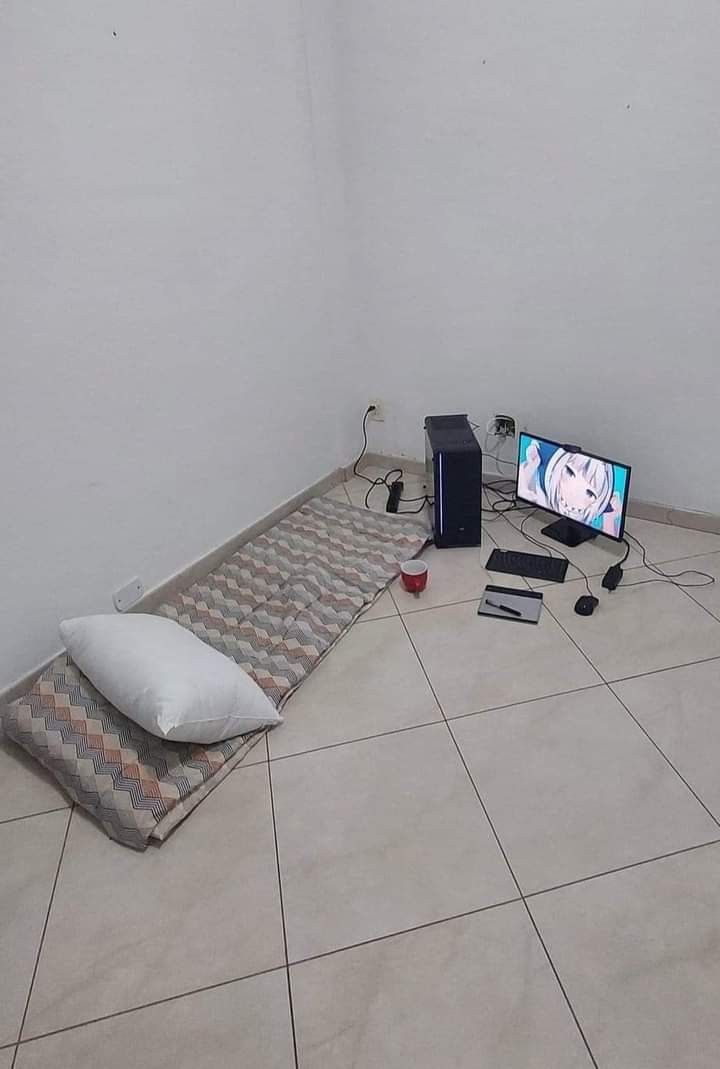
and what it says about masculinity, precarity, and domestic space.
In the interior, he brings together the far away and the long ago. His living room is a box in the theater of the world. – Walter Benjamin
The contemporary Western urban landscape is underscored by precarity and temporariness, at least for most of us. With real estate markets gutted by roughly two decades of neoliberal policy, most of us end up inhabiting spaces typified by instability, neglect, and austerity. Nonetheless, we find ways to navigate these conditions, namely through what I am calling resilient domesticities. This ranges from communal forms of living – like sharing apartments or squatting – to strategic minimalism. I’d like to spend some time on the latter.
When we’re forced to move from place to place, paying incrementally more rent each time, we quickly abandon bulky furniture for the sake of convenience. Bedframes, closets and desks, are the first and most common sacrifices. As a result, your clothes, your bed, your laptop and even yourself are all cruelly relegated to the floor. So, it’s no wonder that the floor-bound mattress has become the common denominator of precarious housing situations in urban contexts around the world, most of us have probably slept on one. I, too, have shamefully spent time on a mattress on the floor.
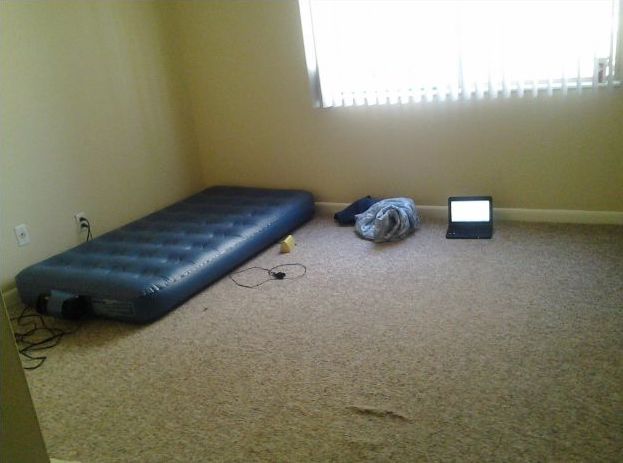
We’ve most likely encountered the ideal male living space memes at one point; depicting a sparsely furnished room with a mattress on the floor, a solitary laptop or PC setup, and maybe a camping chair. While this is a particularly gendered meme, with the obvious suggestion being that men tend to be too lazy to invest in furniture or make their room look nice (both of which are true), the lack of a bedframe is also a result of economic precarity that reaches beyond gender. Bedframes are bulky and expensive, difficult to move around and annoying to take apart, so it makes sense to just get rid of it all together after frequently moving around in a short period of time. The logics of our rooms had to be renegotiated in the face of unstable housing situations, bedrooms became rationalized and functionalized spaces optimized for a handful of basic activities, mirroring the military ethos of demountability and temporariness.
Neglecting the bed(frame) is also symptomatic of an economic system which valorizes work and condemns rest. When domestic spaces are primarily used for productivity, sleep is deprioritized, and the bed becomes an afterthought. The ideal male living space reveals this tendency; if we move beyond its memetic value, it demonstrates the ways in which we navigate increasingly isolated and precarious conditions in increasingly smaller spaces that provide no boundaries between rest and work. The meme therefore finds its value in revealing the politics that underpin domestic spaces.
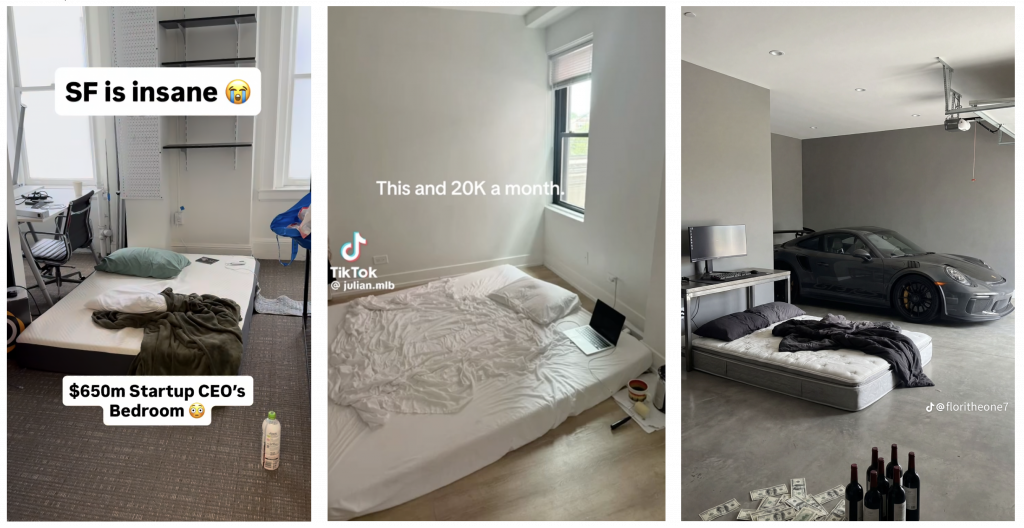
You don’t have to look far to find photos of near-empty rooms captioned with “this and 20k”, millionaire Silicon Valley founders that sleep on the floor, or TikTok larp accounts that use generative AI to create images of luxurious houses that still have a mattress without a bedframe. This consolidates the floor-bound mattress as a representation of entrepreneurial commitment that is ideally sustained even after achieving success. The bedroom has replaced the garage as the symbol of founder culture.
r/malelivingspace
The r/malelivingspace subreddit was created in 2012 and has steadily maintained its memetic relevance ever since. The subreddit reasserts the gendering of space, suggesting that there are inherently masculine or male forms of domesticity. Although it features a wide range of rooms, from austere to abundant, the specific ideal male living space meme finds its origins in a 2018 tweet with a photo of a very sparsely furnished room captioned with “guys really live in apartments like this and don’t see any issue”.

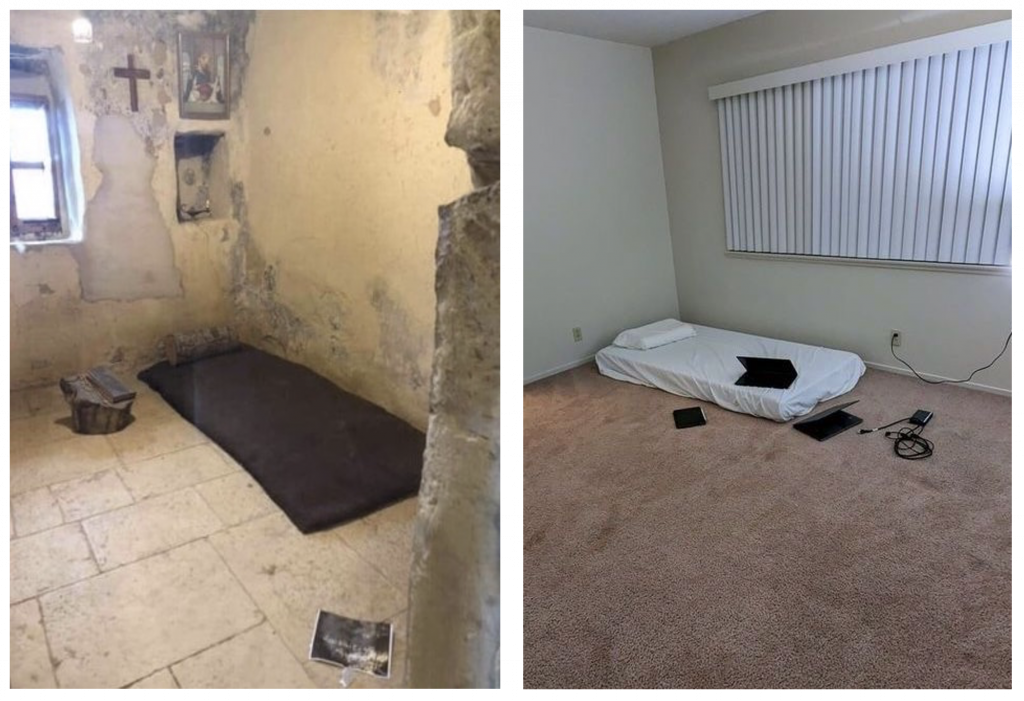
From that point onwards, almost comically minimalist rooms came to be colloquially known as ideal male living spaces. These rooms narrowed domestic life down to the bare essentials: a place to sit, a place to sleep, and a device that grants you access to the internet. All the items in the room are easily transportable: the camping chair folds up, the mattress can be rolled up or deflated, and the computer setup and few other belongings can be packed into roughly one or two moving boxes. They are ideal for the transient occupation of space and therefore don’t resist the flows of precarity but adapt to them, becoming resilient instead.
The ideal male living space also constructs an explicitly manospheric subjectivity, gesturing at nomadism and minimalism as traits which typify a ‘masculine’ man. This is a strategic harnessing of the subjectifying abilities of domestic space. By constructing the ideal male living space, you simultaneously construct the ideal male. And this ideal male is individual, ascetic, nomadic, and disciplined. These qualities, derived for the most part from the stern minimalism of the rooms, are also perpetuated by computational devices: here, they signify a highly rational and technical form of mastery that transforms the space into a technological enclave. Like a battlestation or cockpit, the room becomes a space for oversight and control.
The ideal male living space reached its memetic apex when Kanye West shared a photo of his makeshift bedroom in the backstage area of the Mercedes-Benz stadium in Atlanta. The room featured a bed, a few items of clothing, a large wall-mounted digital clock, and no windows. This was during his recording of Donda, and the room became symbolic of his commitment to the project. The lack of distractions and belongings was a display of focus, mental toughness, and resilience; of the lone male genius trope.
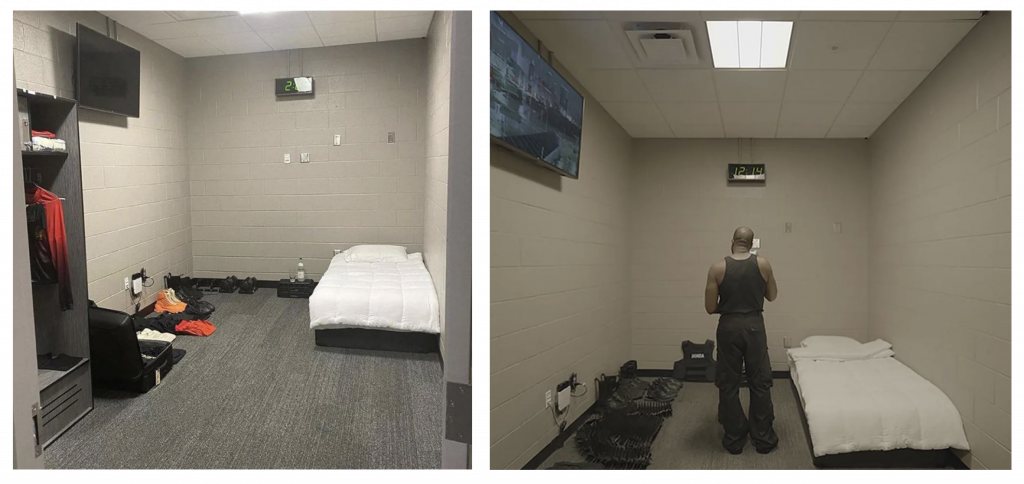
Kanye’s room also mirrored the manner in which religious devotees relinquish their worldly possessions, sacrificing material comforts for a greater good or higher power – it was an act of asceticism in service of his forthcoming album. Take the similarities between the ideal male living space and the monastic cell, for example; the former displaying commitment to masculine values and the latter being minimal due to the monk’s vow of poverty and devotion to his religion. This devotion has been heralded as a moral virtue throughout Western religious history and is henceforth valorized as an aspirational and reactionary masculine ideal. The asceticism of male living spaces is underscored by the mattress on the floor, which has always been central to its iconography. It implies the person sleeping on it can undergo hardship and doesn’t need the comfort of a bedframe. It’s a display of toughness and disregard for rest and comfort, which are consequently framed as feminine desires. Ideal male living spaces are contemporary monastic cells, just replacing the bible with a laptop.
Paranoid Masculinity
Media theorists Jernej Markelj and Jakko Kemper’s framework of paranoid masculinity defines masculine paranoia as “relentlessly policing the boundaries of the self and obsessively shoring up fantasies of autonomy, rationality and (self-)control to ward off the purportedly emasculating forces of alterity, emotion and (addictive) stimulation”1. This emerges from a so-called ‘crisis of masculinity’ that began in the late 18th-century as labor shifted away from its overtly ‘male-coded’ form, when ideas challenging conventional masculinity were introduced into the public sphere2. Paranoia is therefore a response to the meaninglessness of a society organized according to the free-market.
Paranoid masculinities push back against the reorganization of social structures and serve as an affective force that desperately tries to maintain and restore an archaic social order. The male living space enacts this through the construction of a space that temporarily safeguards its inhabitant from an emasculating outside-world. It grants them autonomy through the transportability of furniture, rationality through its functional minimalism, and self control through its lack of stimulation and ‘unnecessary’ decorative commodities. The ideal male living space represents a mythologized notion of masculinity that circulates within the manosphere, reflecting the ‘sigma male’ archetype and its voluntary austerity and entrepreneurial asceticism. As one commenter on an ideal male living space meme notes: women hate how little it takes for us to be happy.

At the same time, these rooms and behaviors reflect the precarious conditions experienced by many young people living in urban contexts, revealing the contradiction ever-present in manosphere politics. The discontent experienced by many young men is often conspiratorially attributed to feminist or queer agendas seeking to undermine ‘traditional’ masculinity. In reality, the root of many of these negative experiences are the failed promises of neoliberalism which are repackaged and sold as conspiracy theories by faux-reactionary opportunists.
The construction of masculine interiorities is one of many reactionary responses to the vertigo induced by late-neoliberal conditions. Processed foods which decrease testosterone, mass-produced slop-content that undermines individuality, and a lack of jobs that require manual labor all threaten the mythologized formulation of masculinity that circulates in the manosphere. The room, the mindset, and even the body all become interiors that can protect this so-called ‘masculinity’ from a hostile and feminizing exteriority. Through these mental gymnastics, living in precarious conditions undergoes a disingenuous mutation which frames it as desirable hardship which will inevitably be rewarded, repackaging precarity as a deliberate choice. In short: you aren’t lonely and isolated; you’re a sigma male. You don’t live in an austere, underfurnished apartment; you’re living in an ideal male living space. You’re not poor, you’re just not rich yet.
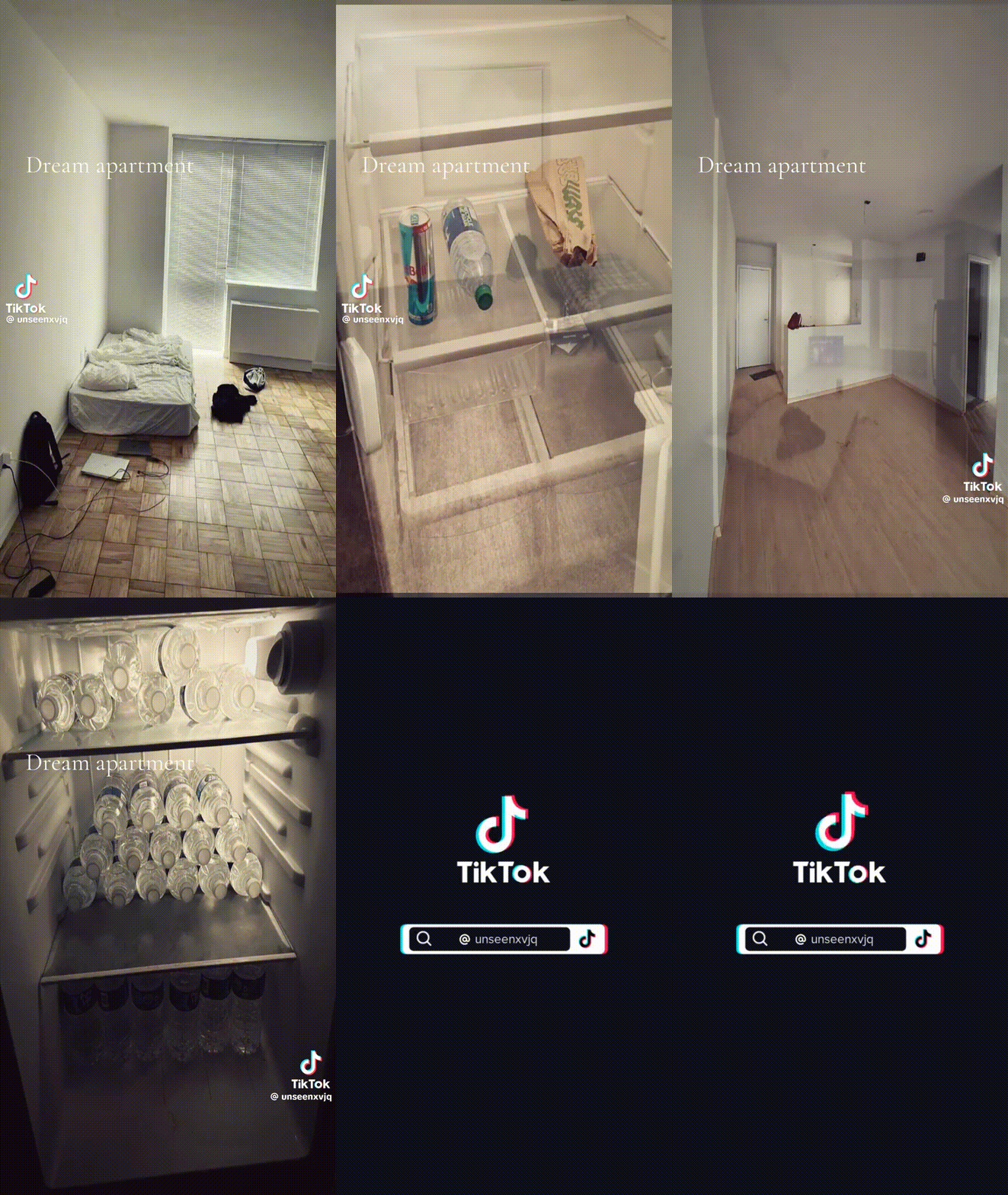
The manosphere formulation of these rooms is just one interpretation of precarity, though. In contemporary urban contexts, it seems so unlikely to have your own apartment that living in a near-empty room becomes a fantasy. This is evidenced by hundreds of videos compiling underfurnished rooms and empty fridges with captions like “freedom” or “dream apartment”. This attitude reproduces a neglect of the structural issues caused by crumbling welfare states; instead of striving to eradicate precarity, it learns to operate alongside and aestheticize it. The failure to identify the structural inequalities that produce these conditions leaves us with a feeling of individual responsibility and a desire for the bare minimum, a form of complicit resilience.
The New World
One hundred years ago, Swiss architect Hannes Meyer created the minimum dwelling, a hyperbolically minimal space that featured a folding bed, folding chairs, folding table, a shelving unit, and a gramophone positioned on the table. Devoid of decoration or non-functional furniture, the space was designed for what he called “The New World” and a radically socialist and collective future. In this world, people would inhabit spaces in co-operative housing with shared facilities, removing the need for those facilities in individual rooms. Meyer’s world would be populated y an international working class liberated from restrictive nationalism, which is why the room lacked any decorative cultural signifiers and the furniture was easily transportable. You may have noticed that Meyer’s room bears an uncanny resemblance to many of the rooms we inhabit today, especially the male living space. Ironically, his vision seems to have been actualized, but not because we inhabit a socialist utopia and practice communal living. One hundred years later, his ideas seem to have fallen victim to the all too familiar phenomenon of neoliberal co-opting of radically progressive proposals.
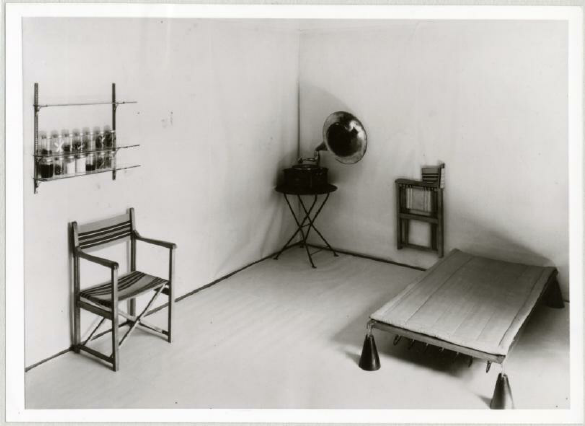
Meyer recognized that private rooms are tools for social organization, individuation, and subjectification, a sentiment that was echoed by architectural collective Dogma, who noted that the architecture of the room articulates our gender and class positions. The private room in particular interpellates us as individuals and celebrates “notions of privacy as the possibility of freedom from the burden and pressures of the social world.”3 If we take the subjectifying function of the private room into consideration, it should come as no surprise that reactionary and fascist movements use domestic spaces to resignify the social order they seek to maintain. They close off and delineate territories, creating an inside versus outside, and an us versus them.
Constructing spaces where to enclose ourselves is far from an uncommon gesture; Peter Sloterdijk famously argued that controlled micro-environments are inherent parts of the human condition. The physical room is a fertile point of departure for this; it’s the most literal way we imagine the inside. The ideal male living space gives us a look inside the ideological forces which govern its design. This constructed interior hinges on a likewise constructed exterior: It’s a retreat into a shell that forecloses critical analysis of why we want to retreat into it in the first place. It grapples with the difficult reality of precarious housing, desperately trying to justify these conditions through myths about discipline, asceticism, and individuation. True becoming entails breaking out of the constructed boundaries of interiority. The male living space looks like a prison cell for a reason.
1Jernej Markelj and Jakko Kemper. ‘The masculine urge to rawdog life: Male paranoia and the gendering of digital detox’, Media Theory, Vol. 10 No. 1 (2026, forthcoming).
2ibid.
3Dogma, The Room of One’s Own, https://www.dogma.name/project/the-room-of-ones-own/.
| Words | Ruben Stoffelen |